

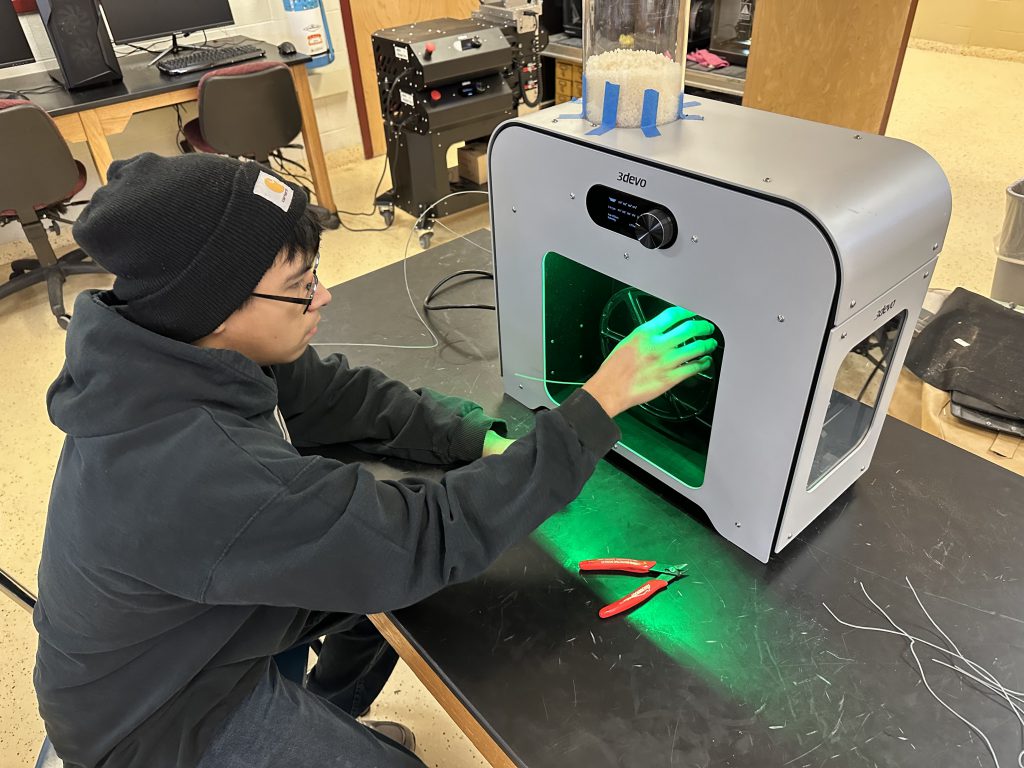
The low, steady hum of 3D printers in one BKW classroom is the source of solutions to real world problems in the community.
Whether it’s a letter tracer helping a pre-K student learn to write, an adaptive tool assisting a local senior with mobility or a custom concrete stamp, students are engineering useful prototypes.
Led by teacher Bill Dergosits, students learn the basics of 3D printing before diving into the engineering and design process to create high-tech prototypes on the district’s grant-funded equipment.
Along with the technical work, a major component of the course is developing problem solving skills and client-consumer relationships. Throughout the year, students have worked with kindergarten classes, family members, business owners and even pets to do just that.
“I wanted the high school kids to have clients that they could actually talk to,” said Dergosits.
For his 3D printing students, having a real client changed the stakes of the assignment.
“It wasn’t just a project to do because a teacher said so; it had a purpose,” one student said. “To build something and understand who was going to use it was a lot of fun and rewarding.”
The collaboration started because Dergosits and his class wanted to help the school district and sought out people to assist. Kindergarten teachers then identified and shared a need for a tool to enhance their students’ learning effectiveness.
While the program has thrived in the four years Dergosits has taught it, he continually pushes for new and relevant challenges. This year, that challenge is sustainability. Dergosits and his students are collecting and recycling plastic waste from the cafeteria to use as 3D printing filament.
“We are creating a closed ecosystem here,” Dergosits explained. “The bottles come into the classroom; they’re rinsed, washed, cleaned, ground up and dried.”
The students are currently in the process of collecting the plastics, and the excitement for the project is strong.
“It’s going to be pretty cool to turn something we would normally throw out into something that helps the school,” one student said.
With this new initiative, BKW is the only school in the country making its own plastic filament from school waste to use with its 3D printing technologies.