

Table of Contents
Departments & Services Links
Our Campus Contact Info
1738 Helderberg Trail
Berne, NY 12023
Phone: (518) 872-1293
Keith Domermuth, Director of Facilities
Capital Project Updates to the Board of Education
Improving BKW’s facilities is a large undertaking that needs a lot of consideration.
Guided by community input given to district officials through various forums, surveys and meetings, BKW has taken almost two years to diligently and responsibly develop a plan that prepares its students for 21st Century learning, is financially responsible, and is sensitive to the community.
View more information below to see the updates given to the BKW Board of Education by Synthesis Architects and M/E Engineering throughout the development of the capital project:
What is a capital project? How do they work?
View our infographic that explains the basics of a capital project (via Google Drive). Feel free to print and share it!
Why Do We Need a Capital Project to Improve Our Facilities?
Just as BKW is dedicated to preparing its students for a successful future, it also invests considerable time and energy into caring for the buildings and classrooms in which they learn.
As times and the needs of students change, so must their learning environment.
A building condition study commissioned by the district and conducted by independent architectural experts found that our buildings and systems are aging, with many of the building systems in the original 70 to 80-year-old portions of the school nearing the end of their useful life. The boilers and steam heating system in the Elementary School were installed 62 years ago. It goes without saying that it’s not the most efficient or reliable way to heat your children’s classrooms. BKW is looking to upgrade the Elementary School’s heating and ventilation system as part of a capital project.
The district can use this opportunity to modernize and upgrade BKW’s learning spaces while addressing these necessary repairs.
What About the Financial Impact?
The project can be accomplished with minimal financial impact on district residents. Nearly 80 percent of the cost would be covered by state building aid.
Because it is funded largely by state building aid and bonds, a capital project enables a school district to invest in its facilities – to make repairs, renovations and updates necessary to address health, safety, learning and working environment issues – with significantly less financial pressure upon local taxpayers and school budgets. Specifically, without a capital project, BKW would miss the opportunity to have nearly 80 percent of aidable project costs covered by state building aid – a significant amount of money for the district and local taxpayers.
BKW can also alleviate the additional local tax impact of a capital improvement project by taking on new debt – through bond financing – as old debt is retired.
It should also be noted that any building project that the voters approve cannot, by law, go over budget. School districts cannot spend above the bond amount approved by voters during the capital improvement project public referendum. If costs begin to exceed those estimated once work begins, the scope of the project must be reduced accordingly.
BKW considered two proposals for a November 2 vote:
- $14.8 million in repair and modernization work primarily in the Elementary School.
- Approximately $5 million in improvements to the Secondary School. This proposition was contingent on the passage of the $14.8 million project.
If both capital project propositions had passed on Nov. 2, the average BKW taxpayer would have seen an increase of only $1 a month for the first 64 months of the loan, according to the district’s fiscal advisors. After the first five years and four months of the loan, school taxes would have returned to the then-current levels.
Why are Changes Needed? What Areas Need Attention?
Daily wear and tear and the aging of the school building and its systems have taken their toll beyond what can be remedied through routine maintenance and repair. At the same time, technology and space requirements for today’s learners are vastly different from the past.
Numerous studies have concluded that students in substandard school buildings perform at lower levels than students in newer, functional buildings. Researchers have found that students in deteriorating school buildings score between 5 to 11 percentile points lower on standardized achievement tests than students in modern buildings, after controlling for income level.
Furthermore, research has found that specific building conditions that would be addressed in a BKW capital project – things like poor air quality, excessive or inconsistent temperatures, poor lighting, and high levels of noise – contribute to lower levels of student performance.
We want to make sure that we use this opportunity not just to maintain our buildings, but also to support our vision for BKW’s students.
The district is looking primarily at repairing and upgrading the elementary school, but does have plans for improving the secondary school lobby, parking, and drop-off areas, and creating a community plaza.
The Proposed Work Included, But Was Not Limited to, the Following:
Elementary School
- Reconstruct West Wing Lower Level (K-1)
- Reconstruct West Wing Upper Level (2-3)*
- Reconstruct Main Building Basement-
- Reconstruct East Wing First Floor (4th)
- Reconstruct Main Building Second Floor (6th)***
- Reconstruct East Wing Second Floor (5th)
- Cafeteria Upgrades for Multi-Purpose Program
- Agricultural STEM Lab Upgrades
Secondary School
- Upgrades to technology infrastructure and wifi
- Security upgrades
- Improved entryway/lobby
- Asbestos removal
- Modernize instructional space
- Distance Learning Space
- Cafeteria Upgrades
Is the Community Involved?
Of course it is –and has been for some time. Since January 2016, the district has sought community input. Community members, civic leaders, architectural and construction experts, first-responders, parents, and family members have given the board feedback and guidance through various forums, surveys, and meetings.
That may be why nearly 90 percent of respondents to the exit survey given at the May 16 school budget vote agree that some repairs and improvements to our schools are necessary.
View the summary of feedback (via Google Drive).
Effect on Student Achievement
The trend toward school facility improvement and potential impact on student achievement: A white paper to support facility improvement in the Berne-Knox-Westerlo Central School District.
Dr. Timothy Mundell, Former Superintendent of Schools
July, 2017
Introduction
In 1996, Penn State University published a study through its Evaluation and Education Policy Analysis department, which highlighted the existing state of public school facilities across the nation. The study pointed out five key understandings:
- 75% of the existing schools in the nation were built prior to 1970
- 67% of all schools were in need of mechanical repair- plumbing, roofing, electrical
- 58% of the buildings had an inadequate environment- ventilation, acoustics, security
- Older buildings were not designed to be conducive for teamwork and collaboration
- Technology infrastructure is a major obstacle
As the world became more digital and technology-based, the task of fixing and upgrading schools to meet the challenge of the future was daunting financially and strategically. In 2000, New York State passed legislation and adopted regulations creating a required reporting process for local districts to identify the major facility maintenance and improvement needs as a means to planning for cost and priority over time. As a result, local districts are required to submit a Building Condition Survey to the New York State Education Department every five years to identify structural and/or mechanical issues that will lead to structural or mechanical system failure within five years. It is the expectation that these identified facility maintenance issues be addressed as a priority by the local district as soon as practical.
To date, NYS has been through two five-year BCS submission periods. During the first five-year period, running through June 2011, there was a clear trend by local districts to submit capital improvement projects focused primarily on fixing broken systems in school buildings. The conservative approach by districts may reflect the urgent need to overcome a backlog of delayed repairs, and also may reflect the stagnant economy of the time.
During the second reporting period, through June 2016, districts have sought to conduct capital improvement projects that not only included addressing BCS-identified issues, but also included innovative plans to redefine the capacity of their local facilities to meet the changing needs in education today. It is here that the Berne-Knox-Westerlo Central School District enters consideration of the status of its local school facilities, necessary maintenance, and innovative improvements.
A Brief Synopsis of BKW
In May, 2015, the Berne-Knox-Westerlo Board of Education hired an architectural firm, Synthesis, LLP, for the purpose of conducting the required Building Condition Survey for submission to NYSED by June 30, 2016. Throughout the course of the 2015-16 school year the firm worked closely with the District to assess the condition of district facilities. In addition to the BCS work, the architects were tasked with developing a five-year facility plan. Parallel to collecting necessary information for the BCS, the architects met with administration and staff to gain insight related to program and instructional needs that could support the development of the five-year facility plan.
The architects provided updates on BCS items to the Board of Education on several occasions during the 2015-16 school year. The BCS was submitted prior to June 30, 2016, and a facility plan was developed and presented to the Board, in the context of the BCS work, in November 2016. From November, 2016 through May, 2017, the Board worked with the architects to define a scope of the work to be included in a capital project proposal for a public referendum anticipated to take place in the fall of 2017.
It is noted that the District has conducted two prior capital projects during the BCS era in NYS, one approved in 2005, and another approved in 2010. Both projects focused predominantly on the Secondary facility and included improvements to comply with Americans with Disabilities Act requirements, as well as improving athletic and cafeteria facilities.
BCS Results and Facility Planning
A copy of the BCS results can be viewed on the District website. Suffice it to say, for this paper, the items identified in the BCS are overwhelmingly located at the Elementary building, as this facility includes sections that were constructed in 1932 and 1955 and have systems in need of major repair, or replacement altogether.
Rather than a simple listing of projects to be addressed, the facility plan organized the projects into four general goals: infrastructure, safety and security, educational program, and organization. While addressing the infrastructure issues, it is also possible to improve and enhance the facility to redefine its capacity of the facility to meet the changed needs of education in the 21st century.
The scope of the proposed capital project includes replacing the heating system by converting from a steam system to a hot water system, replacing roofs, improving the ventilation system, addressing septic system issues, electrical issues, new lighting systems, and adding acoustic padding for noise reduction. Beyond the Elementary building, there is roof work to be completed at the Secondary school, as well as electrical issues and fuel storage issues at the district office facility.
Concerns have been expressed by the community regarding secure entry points of each of the buildings. The Board members, a group of community members, administration, and the architects conducted a walkthrough in January 2017 to identify potential options for enhancing security in each. Options have been developed and included in the proposed cost.
The scope of the proposed project also reflects a STEAM-oriented academic approach to program and instruction, and an effort to create community spaces to enhance the District’s role in serving as an agent of community engagement. The project will modernize and enhance classroom space to allow for flexible instructional practice, teamwork, collaboration, and hands-on, project-based learning, while also improving the air quality, temperature control, lighting, acoustics, and color schemes of each learning space. The project will include a 21st-century science instructional center and enhancements in the cafeteria space that will allow it to more readily serve as a large group instruction space or a well-equipped public meeting space. Similar enhancements to the secondary cafeteria will also be part of the project. While classrooms are under renovation, technology infrastructure will be addressed, including wiring for increased speed and capacity on our local network, the addition of wireless access throughout the school, and the inclusion of a state-of-the-art projection system in each classroom.
The scope of the proposed project at BKW reflects the current trends proposed by districts in NYS. By combining major infrastructure work with a comprehensive plan for the future of program philosophy and instructional practice, districts are optimizing the intersection of NYS-provided building aid on capital projects and the current economic climate of very reasonable interest rates for bonds to cover the cost of the projects. The proposed project at BKW is one that will extend the life expectancy of the major systems of the facility for the foreseeable future, while also ensuring we are preparing students for their future.
Facility Improvement and Student Achievement
According to feedback from an exit survey regarding the proposed capital project, conducted by the District at the annual budget vote on May 17, 2017, 89% of respondents agree that BKW facilities are in need of improvement, and 47% would like a better understanding about the connection between improved facility condition and student performance. Over the past ten years, studies have been conducted to better understand the relationship between facility conditions and student performance. In fact, over sixty years of research continue to support the positive relationship between building quality and student achievement. (Cash & Twiford, 2010).
In their 1996 study, Penn State noted a key finding to be that facility quality is a predictor of student performance and teacher retention. Poor environments in schools adversely influence the health, performance, and attendance of students (Building Minds, 2006). Duran-Narucki’s 2008 study of school building conditions, attendance, and academic achievement in New York City found building conditions to be a predictor of student attendance and student achievement on standardized tests.
The relationship between student and teacher is a key to student performance, making the retention of quality teachers important to student learning. Marzano (2007) has highlighted the relationship between students and teachers as a necessary component of student learning. Attitudes are significant in establishing and maintaining the relationships that enhance learning. Ruszala’s (2008) study on teacher satisfaction and building condition reaffirmed the connection between the condition of the building and the teacher’s attitude.
Several studies have been done in an attempt to determine exactly how building conditions impact student performance. The National Summit on School Design (NSSD) reported eight recommendations for school design excellence. These included designs to support a variety of learning styles and the creation of healthy, comfortable, and flexible learning spaces. While the cumulative effect of the school facility’s condition has been related to student outcomes, further research has been done to pinpoint several specific factors that contribute to this overall phenomenon. These specific factors include lighting, building cleanliness, health and safety, painting, and student and teacher morale. NSSD (2005) recommendations include several references to heating, ventilating, and air conditioning systems to counter those concerns. They indicated that industry trends affecting the quality of the school environment included temperature distribution monitoring that can control and track temperature in all spaces in school buildings, and improved air filters for a healthier environment.
Research has indicated that controlled daylight and appropriate artificial lighting improve the performance of students and teachers and their health (Woodside, 2008). Research by Conway, Epps, and Plympton (2000) supported the relationship between lighting and student test scores and health. They further reported that schools found that increasing natural lighting in construction did not necessarily increase the cost of construction or operational costs. Heschong-Mahone Group (1999) reinforced the positive effect of day lighting in student performance.
Penn State identified five facets of school facilities that are important to supporting student performance. These include:
- Acoustics/Noise Reduction: Excessive noise causes stress/dissatisfaction;
- Less external noise has been associated with greater engagement and achievement
- Recommendation: Buffer existing noise
- Less external noise has been associated with greater engagement and achievement
- Air quality: Poor air quality contributes to absenteeism
- Sick building syndrome: poor ventilation leads to bacteria, viruses, etc. Indoor pollutants include equipment, paint, cleaning products, etc.
- Recommendation: Improve ventilation
- Sick building syndrome: poor ventilation leads to bacteria, viruses, etc. Indoor pollutants include equipment, paint, cleaning products, etc.
- Lighting: Research has shown that artificial lighting has a negative impact on those in school. Natural light has a positive effect. Natural light boosts the morale of staff and students, reduces off-task behavior, and improves test scores. Natural light leads to 20% quicker math growth and 26% quicker reading growth
- Recommendation: Gain natural lighting
- Proper temperature and control of temperature: Temperature affects engagement and productivity, including student achievement. Ideal temperature ranges from 68-74 degrees
- Recommendation: Control temperature in individual rooms, or at least within a small block of rooms
- Classroom size and space: Overcrowding is linked to increased levels of aggression among students. Overcrowding is associated with decreased levels of engagement and learning. Rooms must have ample space to be conducive to appropriate learning activities, 21st-century work, teams, problem-solving, and communication. Rooms must allow for re-configuration of seating, including private study areas, small group learning centers, and reduction of audio and visual interruption.
- Recommendation: Design flexible space classrooms- define flexible space, think space, and other space concepts
We can draw a conclusion that by repairing and/or replacing mechanical and structural systems, the district will improve the condition of the facility. According to the research, the improved condition will directly relate to improved student performance and improved morale among students and staff. Repair or replacement of systems in these areas is a worthwhile investment to maintain the useful life of the building, as well as to provide a healthy learning/working environment for students and staff, while adapting to the changing future in education practices.
Recommendations for Design Planning
A symposium held in California in 2008 entitled, Re‐Visioning School Facility Planning and Design for the 21st Century: Creating Optimal Learning Environments, outlined “A Framework for School Design Excellence.” It is offered here as a practical reference point in thinking about the proposed project as it relates to improving student performance.
- Design Schools to Support a Variety of Learning Styles: Focus on a new learning environment that is designed to support student achievement. Doing so requires greater flexibility in design to accommodate a range of learning scenarios inside and outside the school.
- Enhance Learning by Integrating Technology: There are two key technology issues: green building design and the gap between how students experience technology in their real life and how they experience technology in their school life.
- Foster a Small‐School Culture: Communities have a strong penchant for developing a small‐school culture that fosters relationships and attachments. Students agreed.
- Support Neighborhood Schools: It’s such an integral part of our cultural experience, the relationship between a school and the neighborhood it serves. It’s what many argue is part of a healthy community.
- Create Schools as Centers of Community: Facilities are used not only as a school but also as a place to house other community services such as recreational centers, resource centers, and performing arts spaces.
- Engage the Public in the Planning Process: A great deal of planning and time is required for a school district and a community to plan this process.
- Make Healthy, Comfortable, and Flexible Learning Spaces: Research continues to demonstrate the significance of spatial configurations and design elements, including color, daylighting, heating/cooling, and ventilation in student achievement.
- Consider Nontraditional Options for School Facilities and Classrooms: For example, the nationwide initiative to promote Science, Technology, and Math (STEM) schools, nurturing students to go into STEM‐related fields.
Closing Thought
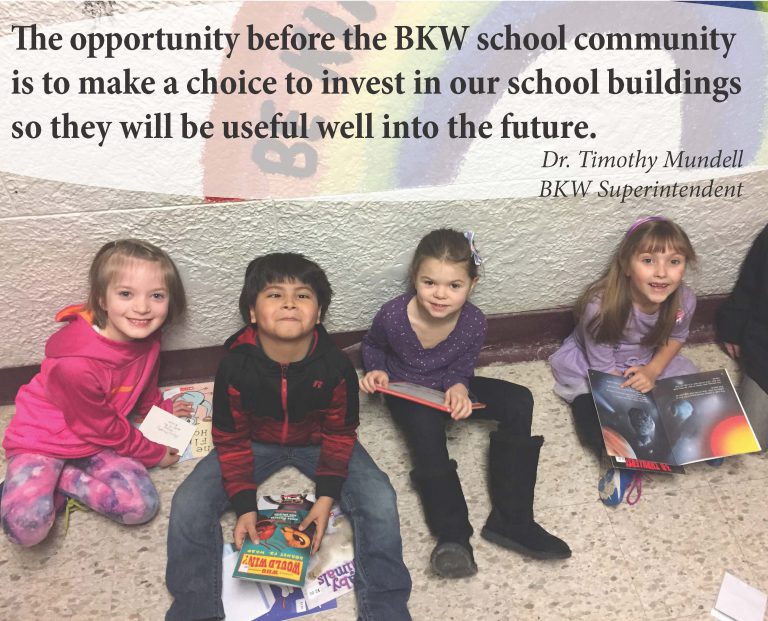
The opportunity before the BKW school community is to make a choice to invest in our school buildings so they will be useful well into the future. The research provides us with understanding about how to invest resources to ensure that the structure in which students learn and teachers teach indeed supports optimal performance. The District has the opportunity to not only fix mechanical and structural issues in the elementary facility, but also create a learning environment aligned with current and future trends in teaching and program design. Doing so will contribute to preparing students for their future.